


In August, the Senate Finance Committee held a hearing to talk about the nation's Social Security problem. As taxpayers, we should be happy to hear that after two hours together, pulling in witnesses from AARP, the CRFB, and many prominent senators, we learned that they agreed that Social Security is worth discussing.
What an anticlimactic meeting.
The hearing was titled “Exploring Process Approaches for Addressing Social Security Solvency”, which sounds productive.
By the end of the hearing, the takeaway was simply that a group of senators will now meet with private consultants to discuss the problem.
The Problem
As a Certified Financial Planner, a lot of people have asked me questions like:
“Isn't Social Security going to run out of money?”
If you look for articles online, you certainly might think that.
The truth is closer to a little bit of a yes, and a little bit of a no.
The Social Security Administration carries a trust fund, called The Old-Age and Survivors Insurance (OASI) Trust Fund. When your payroll taxes are withheld from your paycheck to pay for Social Security, they go into this trust fund. When Social Security payments are made, they come out of the OASI Trust Fund.
https://www.ssa.gov/oact/progdata/describeoasi.html
We recently learned that by the year 2034, the Social Security Administration will collect less money in payroll taxes than it pays out in benefits. If Congress does nothing, then current Social Security benefits would be cut by about 22%. That would be $440 cut for someone whose Social Security check is $2,000/month.
https://www.ssa.gov/news/en/press/releases/2026-06-09.html?utm
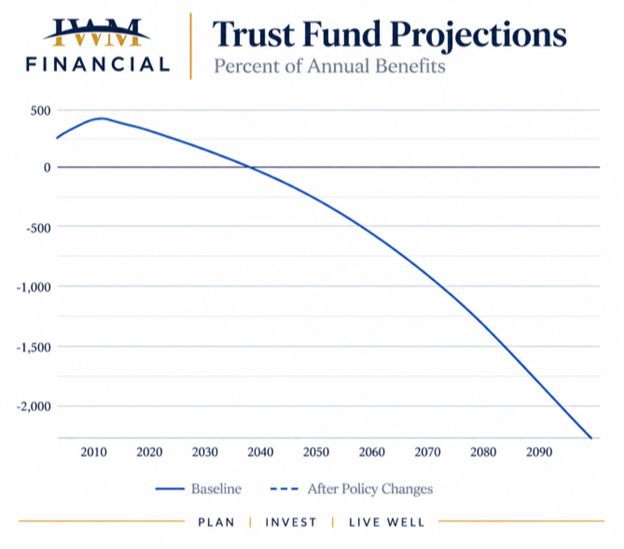
This would cause a retirement crisis.
The system is clearly broken, and Congress will have to fix it.
The Solution
It’s hard for me to believe that Congress would actually let Social Security benefits be reduced. Do you really think that the grandma down the street living on a fixed income of $2,000/month can afford losing $440 per month?
I think not.
Congress will have to do some combination of decreasing expenses (cutting benefits) or increasing revenue (increasing taxes) in some way.
https://www.iwmfinancial.com/resource-center/retirement/social-security-the-elephant-in-the-room
Most, if not all of these, raise controversies. The trick is to find a solution that can actually pass both the House and the Senate, then be signed into law.
Let’s look at the options on the table.
The government agency Committee for a Responsible Federal Budget (CRFB) provides a great interactive tool you can use to test benefits called “The Reformer”. I encourage you to jump online and play with the tool yourself.
https://www.crfb.org/socialsecurityreformer/?utm
I’m going to break down some of the most notable potential changes and show how much each could help close Social Security’s funding shortfall, referred to as “% of Gap Closed.”
Keep in mind that many of these solutions overlap, so combining them requires some additional math to see the full impact. Fortunately, the Reformer webpage does that math for you.
Increase Taxes:
● Congress could increase the 6.2% payroll FICA tax to 8% to fund the gap by 60%.
● Removing the cap on wages subject to payroll taxes (currently $184,500 in 2026) closes the gap by 44%.
● Start charging federal employees Social Security taxes only closes the gap by 5%.
● Making payroll subject to Social Security FICA tax before health insurance provided by your employer is paid closes the gap by 20%.
(Are you starting to feel anxious about these potential changes?)
Decrease Benefits
● Increasing the Full Retirement Age (FRA) from 67 to 68 only closes the gap by 11%.
● Changing Cost of Living Adjustments (COLA) from CPI-W to “Chained CPI” closes the gap by 16%.
● The SSA could cap benefits for a married couple at $100,000/year. That closes the gap by 55%.
● Or, do a wide breadth of cutting benefits.
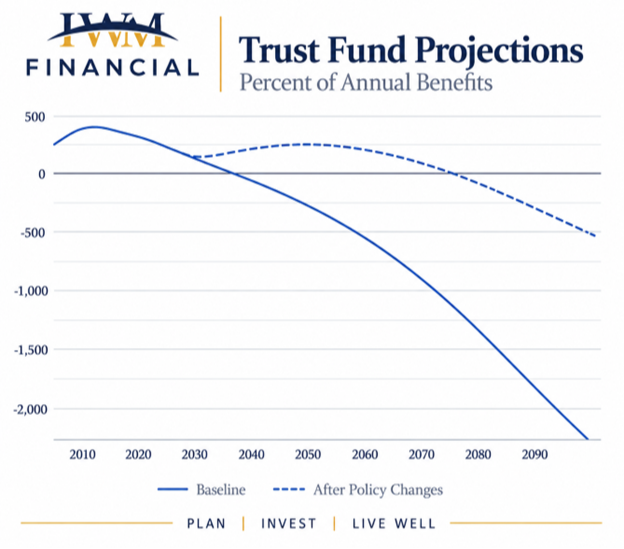
There have been some suggestions to combine changes in a way that would lighten the burden of cuts. One option we have heard before is:
● Increase payroll tax by 1.8% so both the employee and employer pay in 9%, AND
● Uncap the Social Security Wage Base for all W-2 earnings, AND
● Pair that with a newly established Basic Minimum Benefit so those with no benefits could earn up to $900/month per person, or $1,341/month for couples.
This give-and-take approach closes the gap by 76% and pushes the shortfall out 75 years.
What is all means
Ultimately, Congress is going to have to take action.
As financial planners, we find it hard to believe Congress will let benefits be reduced by 22%. However, as proactive savers, we should be able to test how this would affect a retirement plan. In our retirement planning process, we have tested to determine how it would look if there was a 22% cut in Social Security. That way, you could have confidence that your retirement plan is successful.
Social Security will continue to remain uncertain. The Senate Finance Committee came to no conclusions in their hearing other than talking about how important it is to talk about the problem.
There have been proposed solutions presented before, and even though they have not taken hold, your financial plan still has to move forward.
Social Security should be viewed as a part of your Retirement Income Plan. When to claim your benefits, how Social Security coordinates with your investments and pensions, which accounts you draw from first, and how taxes may affect your retirement income, can all have a meaningful impact on the years ahead.
If you are planning for retirement, or are already retired, you should understand your options. If a Structured Income Retirement Plan sounds helpful, reach out to our office. We believe in planning first, and investing second, so the conversation on how to maximize your lifetime income should start with a conversation on where you are today, where you want to go, and what adjustments may help you get there.
Schedule a complimentary consultation with an IWM Financial advisor to review your financial plan and identify opportunities to make sure your money is working the way you intend. https://www.iwmfinancial.com/call