


Hey, what’s the market going to do next year?
How’s the economy going to look?
Are we really that up in our account?
Weren’t we supposed to have a recession?
All great questions that we fielded in the fall stretch.
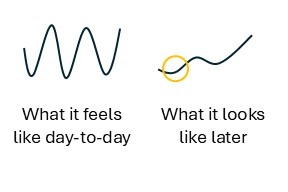
I hear the quote referring to raising kids: the days are long, but the years are short.
I think that has a LOT in common with retirement planning.
Here are a few things we’re watching in the months ahead:
Congress hasn’t paid the bills yet. Here comes another debt ceiling conversation.
The federal government’s credit card limit, aka the debt ceiling, is the cap on the total amount the U.S. can borrow. After much debate, Congress had decided not to be concerned about how much the debt ceiling is and had suspended it as part of a deal made in the last Congressional fight.1
Come January, the cap returns, and it will likely kick off a fresh round of debates and fill up our news feeds claiming the $35 trillion U.S. debt sky is falling.2
With a single-party controlled congress, will the drawn-out debate caused by a lack of planning go easier?
We'll have to wait and see.
Tax cuts may be extended past 2025.
During the last Trump administration, a bunch of tax laws were put in to reduce taxes, including3:
- Lower tax brackets (yes we had lower tax brackets during the Biden administration than the beginning of the first Trump administration)
- A higher standard deduction
- A Qualified Business Income deduction (QBI)
- A much higher estate tax limit3
All these tax cuts led to less tax revenue. Some argue that less taxes caused the economy to grow more, which helps tax revenue, but that argument is hard to quantify.
The current tax law is set to change back to the old tax law after 2025, what we commonly refer to as the “sunset”.
Tariffs could become a key issue for businesses.
The new administration has announced plans for broad tariffs on imports, especially on goods from China.4
Tariffs can impact inflation and business earnings by increasing the cost of goods and supplies from overseas.
If trading partners respond by adding their own tariffs on U.S. goods, it could hurt overseas demand by making our products more expensive.
How deep or broad those tariffs could be is a big source of uncertainty going into the new year.
However, it’s likely that any new policies would come with many rounds of debate, so the actual impact of tariffs may be much less than the worst-case scenarios.
We'll keep you updated.
Markets may be volatile.
This one is a given… markets are ALWAYS thought to be volatile.
While the uncertainty of the election has faded, new uncertainty around policy priorities has replaced it.
We're expecting volatility ahead as analysts digest reports and adjust their positions ahead of the new year.
Investors are also watching data for hints about where the economy is headed next.
The bull market is now over two years old. Should we be worried that a bear market is around the corner?
Probably not.
The chart below shows you the average age of recent bull markets.
While the past doesn’t predict the future, we can see that two years isn’t historically long for a bull market. In fact, the longest bull market on record lasted more than 12 years.5
A sudden turn to a bear market is not likely at this point.
On the other hand, there are a lot of risks in this environment that could shake things up.
If geopolitical issues flare, inflation rebounds, or the business environment starts to look dicey, we can expect markets to correct.
We’re carefully watching trends as we enter the final weeks of the year and thinking about what the new year could bring.
P.S. New administrations often bring extra uncertainty about money. If you have anyone in your life who is worried about what could come next, please let me know. I'd be happy to offer my perspective on their situation.
Sources:
1. https://bipartisanpolicy.org/blog/debt-limit-2025-treasury-cash-on-hand/
2. https://fiscaldata.treasury.gov/americas-finance-guide/national-debt/
3. https://tax.thomsonreuters.com/blog/what-to-know-about-tcja-expiration/
4. https://www.yahoo.com/news/trumps-proposed-tariffs-raise-prices-205300785.html
Chart sources: https://finance.yahoo.com/news/the-bull-market-is-2-years-old-heres-where-wall-street-thinks-stocks-go-next-100050648.html?guccounter=1
*Current bull market as of 11/20/24
Risk Disclosure: Investing involves risk including the potential loss of principal. No investment strategy can guarantee a profit or protect against loss in periods of declining values. Past performance does not guarantee future results.
This material is for information purposes only and is not intended as an offer or solicitation with respect to the purchase or sale of any security. The content is developed from sources believed to be providing accurate information; no warranty, expressed or implied, is made regarding accuracy, adequacy, completeness, legality, reliability, or usefulness of any information. Consult your financial professional before making any investment decision. For illustrative use only.